Twenty-five years ago, I had a lab running old SPARCs that I used for learning Unix and Solaris. This experience led me to my career as a DevOps engineer.
When I got married and had to move, there was no space for my lab in the new home, so I put it in storage. A few months later, I realized that storage wasn’t a viable solution, as the costs would eventually exceed the value of the equipment. I had to make the hard decision to dump most of it, a bad decision then, and even worse today.
At the time, I had a maxed-out SPARC IPX, a SPARCstation 20 with Quad 125MHz CPUs and 4MB VRAM, and Ultra5. To prepare for the disposal, I removed the SPARCstation 20 CPUs, VSIMM, and RAM, put them them into a small plastic box that I kept in a drawer for 20 years.
Two years ago, after I was laid off and soft-retired, I decided to rebuild my SPARC lab; which proved difficult, as these machines have become niche collector items. I eventually acquired a SPARCstation 20, 10, 2, and Ultra10.
When I opened my little box, I was surprised to find three SM71 Processors: a HyperSPARC dual 120 MHz, a 200Mhz, 150Mhz, and 100Mhz. I also found most of the RAM and a 4MB VSIMM. Sadly, the dual 125Mhz didn’t work, but the other HyperSPARCs were fully functional. One of the SM71s, however, had a cracked CPU die and was unfixable.
I popped in the 200 MHz CPU, RAM, and an SCA SCSI drive. It booted, and I was able to install Solaris 2.6. Next, I installed the VSIMM, but it wouldn’t power on. Upon inspection, the reason was apparent: during my move or storage, some capacitors had gone AWOL.
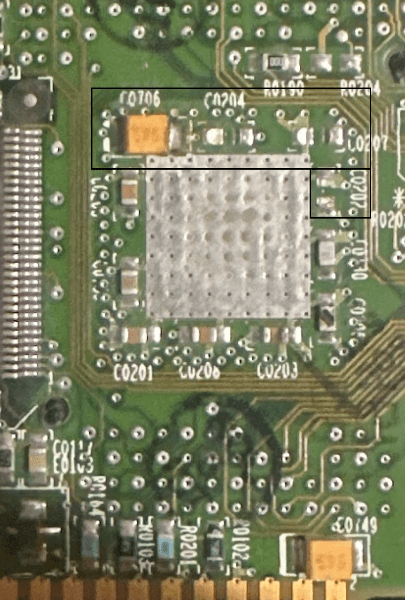
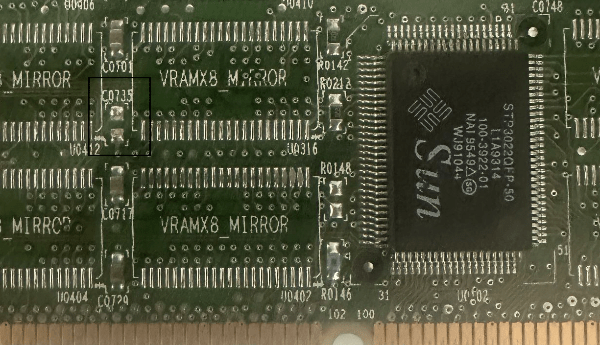
Tantalum C0706 was broken, and C0204, C0207, and C0202 were missing. All of these surround the RAMDAC (Brooktree BT463) video controller chip. The C0706 is the power filter that absorbs spikes; the smaller ones are MLCC capacitors that reduce noise. The standard for these is 100nF 16V.
Since SPARCstation VSIMMs are rare by 2026, I had to attempt a repair. The tantalum was easy; under a magnifier, I identified it as 22uF 16V (C package). After soldering the missing parts,
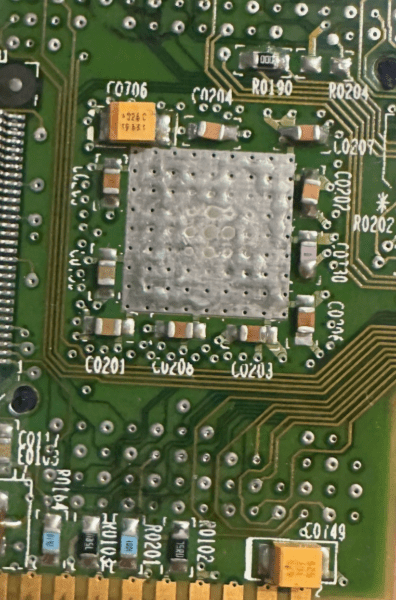
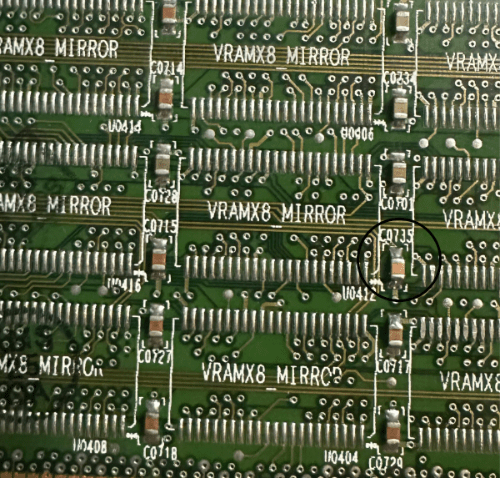
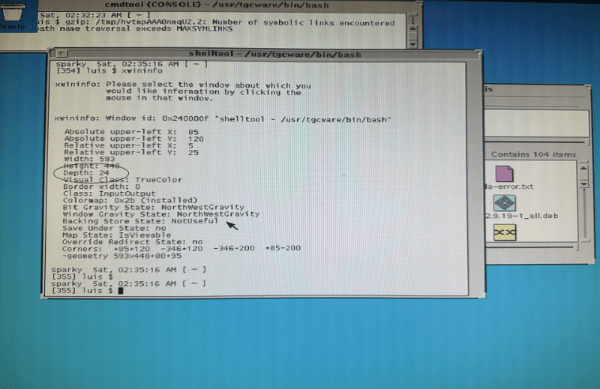
I went the final test: I inserted it into my SS20 and fired it up. To my surprise, I got a console display and successfully launched OpenWindows in 24-bit mode using:
openwin -dev /dev/fb -defdepth 24
With only one one SPARCstation 20 at my disposal and one with a 8MB VSIMM in it, The second VSIMM slot is for a second framebuffer (video card) that connects to the SBUS slot and is made of unobtanium, I decided to return the 4Mb VSIMM to storage and keep it ready for a future use.